
- Compression of the median nerve at the wrist
- Causes numbness, tingling and pain in the hand, often worst upon waking first thing in the morning
- The most common nerve entrapment
- Diagnosed clinically, confirmed with nerve conduction studies
- Treated with splinting, injections, or a quick carpal tunnel release
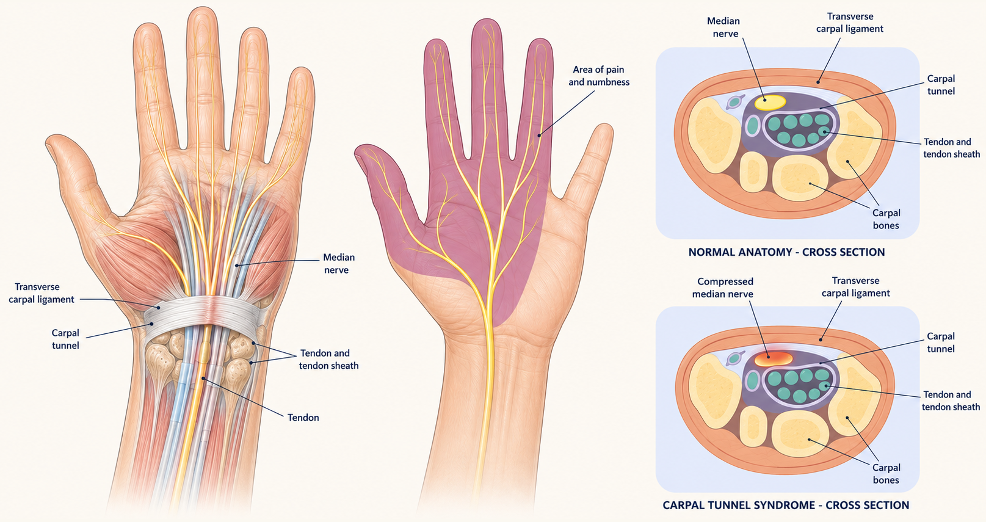
The median nerve and its branches in the hand (left); the area of numbness and pain (centre); and the carpal tunnel in cross-section, normal above and compressed below (right).
- Excess body weight — obesity roughly doubles the risk. 3
- Diabetes, an underactive thyroid, rheumatoid arthritis and other inflammatory joint disease.
- Previous wrist fracture or injury.
- Pregnancy — about a third of women report carpal tunnel symptoms, largely from fluid retention. 4
- Occupational hand-transmitted vibration and forceful, highly repetitive hand work.5
- A family history — carpal tunnel syndrome has a substantial inherited component.
- Numbness and tingling in the hand — classically the thumb, index and middle fingers and the thumb side of the ring finger, although in practice symptoms are often felt more diffusely across the whole hand.
- Waking at night — the single most characteristic feature. Patients typically wake in the early hours with a numb, painful hand and gain relief by shaking it or hanging it out of bed.
- Aching or burning pain in the wrist and hand, sometimes extending up the forearm.
- Clumsiness and dropping things — difficulty with buttons, keys and fine tasks.
- Later features — numbness that is constant rather than intermittent, visible wasting of the muscle bulge at the base of the thumb, and weakness lifting the thumb away from the palm.
Symptoms are frequently present in both hands, and when nerve testing is performed many of the apparently unaffected hands prove to be abnormal already.
- Cervical radiculopathy — a pinched nerve in the neck, particularly at C6 or C7, causing numbness in the same fingers. See the separate Victoria Neurosurgery information sheet on cervical radiculopathy.
- Ulnar neuropathy at the elbow (cubital tunnel syndrome) — numbness of the little and ring fingers with weakness of grip.
- Generalised peripheral neuropathy, for example from diabetes — glove-like numbness in both hands and often the feet.
- Arthritis at the base of the thumb or tendon problems around the wrist — pain, but not true numbness.
These can also coexist. It is not unusual to have both a compressed nerve root in the neck and carpal tunnel syndrome in the same arm — sometimes called a “double crush” — and part of the assessment is deciding which is producing the symptoms that trouble you most.
- Night splints — a splint worn overnight holds the wrist straight, the position in which pressure inside the tunnel is lowest. It is a reasonable, low-risk first step, particularly for mild or intermittent symptoms and in pregnancy. The evidence is weaker than its popularity implies: a review of 29 trials concluded there is insufficient evidence to establish how much splinting helps, 12 and in a randomised trial comparing splinting with surgery, 41% of splinted patients had come to surgery within 18 months. 13
- Corticosteroid injection — an injection into the carpal tunnel gives genuine relief for up to about six months and modestly reduces the chance of needing surgery in the first year. It is not a long-term solution: in a placebo-controlled trial, 73% of patients given the higher steroid dose still came to surgery within a year, compared with 92% given placebo, 14 and current guidelines state on strong evidence that injection does not produce long-term improvement. 8 It is most useful for short-term relief, in pregnancy, or where surgery must be deferred.
- Treating contributing conditions — optimising diabetic control, treating an underactive thyroid, weight reduction and modifying heavy vibrating tool use are all sensible, though none has been shown on its own to reverse established compression.
A number of widely offered treatments have been tested and do not produce lasting benefit: oral corticosteroids (which help only briefly), anti-inflammatory tablets, diuretics, vitamin B6, therapeutic ultrasound, low-level laser, kinesiotaping, shockwave therapy, platelet-rich plasma, hydrodissection, nerve and tendon gliding exercises, and manual therapy. 8 It is reasonable to try simple conservative measures; it is not reasonable to spend many months and considerable expense on treatments the evidence does not support while a nerve is being progressively compressed.
- Symptoms persist despite an adequate trial of non-operative treatment — usually 6 to 12 weeks of night splinting, with or without an injection.
- Sleep is regularly disturbed, or hand function is meaningfully limited.
- Numbness has become constant, there is wasting at the base of the thumb, or thumb abduction is weak — in which case surgery should not be delayed.
- Nerve conduction studies show severe involvement.
Surgery is more effective than continued splinting: in the principal randomised trial the success rate at three months was 80% after surgery compared with 54% with splinting, and 90% compared with 75% at eighteen months. 13 The decision is made individually, on the severity of your symptoms, the state of the nerve, and how much the condition is affecting your life.
- Elevation — keep the hand elevated for the first 48 hours, while the bulky dressing is still on, to reduce swelling and the pain that goes with it.
- Dressing — reduced to a simple adhesive dressing after two to three days.
- Using the hand — light activities from the first day, within the limits of comfort.
- Driving — usually around 1 to 2 weeks, once you can grip the wheel and brake safely.
- Office or non-manual work — around 3 weeks, though many return sooner on modified duties.
- Manual work — around 5 to 6 weeks, depending on the demands of the job.
- Grip strength — dips in the first weeks, returns to baseline by around 3 months and is typically better than before surgery by 6 months.
- Night symptoms — usually the first thing to settle, often within days.
- Numbness — recovers over weeks to months. Where compression has been severe and longstanding, some numbness may be permanent.
Routine supervised hand therapy and routine post-operative splinting are not required and current guidelines recommend against prescribing them as a matter of course. 8 Please contact the rooms if the wound becomes increasingly red, hot or swollen, if it discharges, if you develop a fever, or if pain increases rather than settles after the first few days.
Carpal tunnel release is among the safest operations performed on the upper limb and serious complications are rare. Risks include:
- Scar tenderness and “pillar pain” — aching either side of the scar, noticed when taking weight through the palm; common in the early months and the great majority settle by six months.
- Wound infection — well under 1%.
- Altered sensation around the scar — usually temporary.
- Incomplete relief or persistent symptoms — more likely where compression has been severe and
longstanding, and in patients with diabetes. - Recurrence requiring further surgery — approximately 1% at five years and 1.6% at ten years. 16
- Injury to the median nerve or one of its branches, including the small motor branch to the thumb muscles — rare.
- Complex regional pain syndrome — an uncommon disorder of persistent pain, swelling and stiffness.
- Anaesthetic and general surgical risks — very low for a short day procedure, and lower again under local anaesthetic alone.
- Atroshi I, Gummesson C, Johnsson R, Ornstein E, Ranstam J, Rosén I. Prevalence of carpal tunnel syndrome in a general population. JAMA. 1999;282(2):153-158. doi:10.1001/jama.282.2.153
- Louie D, Earp BE, Collins JE, et al. Outcomes of open carpal tunnel release at a minimum of ten years. J Bone Joint Surg Am. 2013;95(12):1067-1073. doi:10.2106/JBJS.L.00903
- Shiri R, Pourmemari MH, Falah-Hassani K, Viikari-Juntura E. The effect of excess body mass on the risk of carpal tunnel syndrome: a meta-analysis of 58 studies. Obes Rev. 2015;16(12):1094-1104. doi:10.1111/obr.12324
- Meems M, Truijens S, Spek V, Visser LH, Pop VJM. Prevalence, course and determinants of carpal tunnel syndrome symptoms during pregnancy: a prospective study. BJOG. 2015;122(8):1112-1118. doi:10.1111/1471-0528.13360
- Kozak A, Schedlbauer G, Wirth T, Euler U, Westermann C, Nienhaus A. Association between work-related biomechanical risk factors and the occurrence of carpal tunnel syndrome: an overview of systematic reviews and a meta-analysis of current research. BMC Musculoskelet Disord.
2015;16:231. doi:10.1186/s12891-015-0685-0 - Westin O, Fosbøl EL, Maurer MS, et al. Screening for cardiac amyloidosis 5 to 15 years after surgery for bilateral carpal tunnel syndrome. J Am Coll Cardiol. 2022;80(10):967-977. doi:10.1016/j.jacc.2022.06.026
- Arbelo E, Protonotarios A, Gimeno JR, et al. 2023 ESC Guidelines for the management of cardiomyopathies. Eur Heart J. 2023;44(37):3503-3626. doi:10.1093/eurheartj/ehad194
- American Academy of Orthopaedic Surgeons. Management of Carpal Tunnel Syndrome: Evidence-Based Clinical Practice Guideline. Adopted by the AAOS Board of Directors May 18, 2024. https://www.aaos.org/cts2cpg
- Witt JC, Hentz JG, Stevens JC. Carpal tunnel syndrome with normal nerve conduction studies. Muscle Nerve. 2004;29(4):515-522. doi:10.1002/mus.20019
- Ortiz-Corredor F, Enríquez F, Díaz-Ruíz J, Calambas N. Natural evolution of carpal tunnel syndrome in untreated patients. Clin Neurophysiol. 2008;119(6):1373-1378. doi:10.1016/j.clinph.2008.02.012
- Padua L, Aprile I, Caliandro P, Mondelli M, Pasqualetti P, Tonali PA. Carpal tunnel syndrome in pregnancy: multiperspective follow-up of untreated cases. Neurology. 2002;59(10):1643-1646. doi:10.1212/01.wnl.0000034764.80136.ef
- Karjalainen TV, Lusa V, Page MJ, O’Connor D, Massy-Westropp N, Peters SE. Splinting for carpal tunnel syndrome. Cochrane Database Syst Rev. 2023;2(2):CD010003. doi:10.1002/14651858.CD010003.pub2
- Gerritsen AAM, de Vet HCW, Scholten RJPM, Bertelsmann FW, de Krom MCTFM, Bouter LM. Splinting vs surgery in the treatment of carpal tunnel syndrome: a randomized controlled trial. JAMA. 2002;288(10):1245-1251. doi:10.1001/jama.288.10.1245
- Atroshi I, Flondell M, Hofer M, Ranstam J. Methylprednisolone injections for the carpal tunnel syndrome: a randomized, placebo-controlled trial. Ann Intern Med. 2013;159(5):309-317. doi:10.7326/0003-4819-159-5-201309030-00004
- Vasiliadis HS, Georgoulas P, Shrier I, Salanti G, Scholten RJPM. Endoscopic release for carpal tunnel syndrome. Cochrane Database Syst Rev. 2014;2014(1):CD008265. doi:10.1002/14651858.CD008265.pub2
- Ferrin PC, Sather BK, Krakauer K, Schweitzer TP, Lipira AB, Sood RF. Revision carpal tunnel release following endoscopic compared with open decompression. JAMA Netw Open. 2024;7(1):e2352660. doi:10.1001/jamanetworkopen.2023.52660
- Carroll TJ, Dussik CM, Clary Z, Hoffman S, Hammert W, Mahmood B. Endoscopic versus open carpal tunnel surgery: risk factors and rates of revision surgery. J Hand Surg Am. 2023;48(8):757-763. doi:10.1016/j.jhsa.2023.05.002
- Dunn JC, Kusnezov NA, Koehler LR, et al. Outcomes following carpal tunnel release in patients receiving workers’ compensation: a systematic review. Hand (N Y). 2018;13(2):137-142. doi:10.1177/1558944717701240